 Bestseller
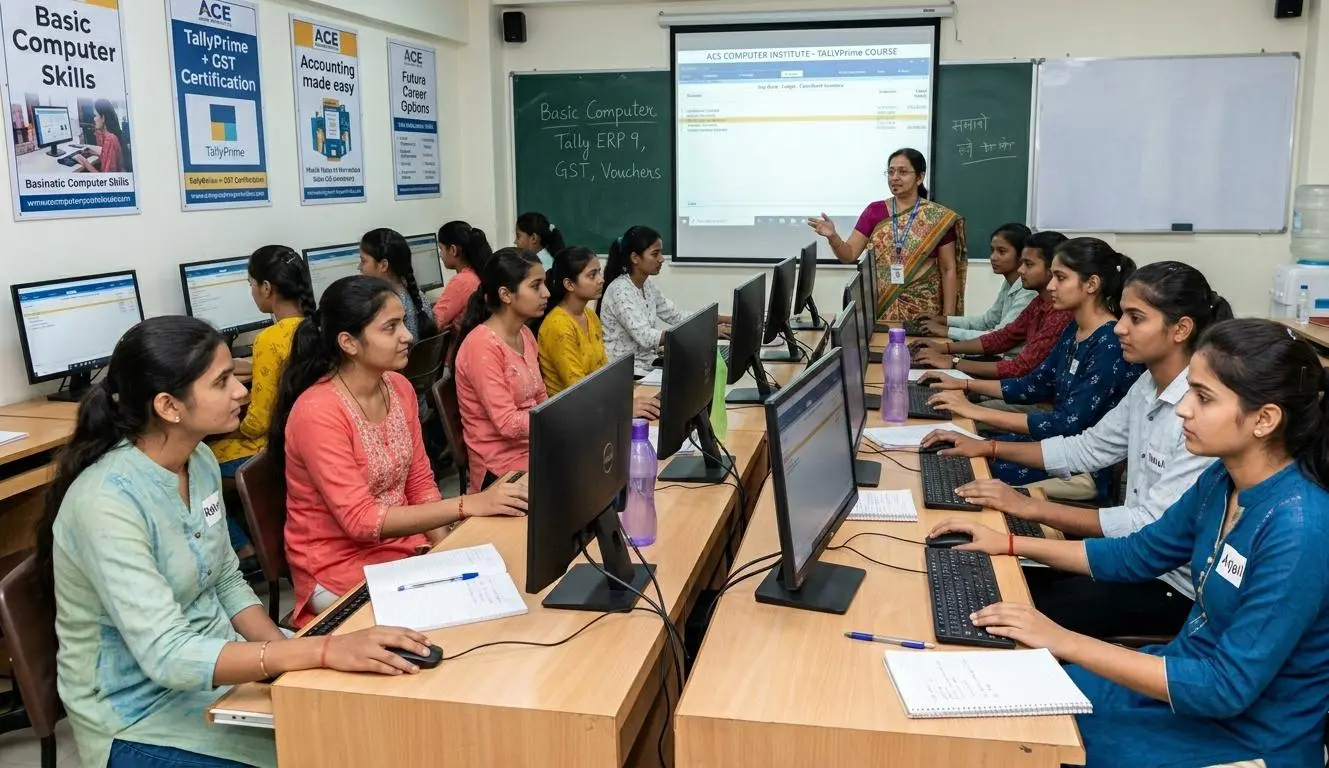
The Smart Accounting course is a comprehensive, job-oriented program designed to equip learners with strong foundations in *computer applications, accounting principles, taxation, and computerized accounting systems*. The course integrates theoretical knowledge with practical training, enabling students to confidently handle real-world accounting and office tasks.
The program begins with *fundamentals of computers, operating systems, and Microsoft Office tools such as **MS Word, Excel, and PowerPoint, with special emphasis on **Excel for accounting and data management*. Students gain hands-on experience in internet usage, email communication, online banking, e-commerce, and professional job-search platforms.
The accounting component covers *basic accounting concepts, rules of debit and credit, journal entries, ledger posting, and final accounts, ensuring a strong conceptual base. Learners are trained extensively in **Tally ERP 9*, including company creation, voucher entry, inventory management, banking transactions, budgeting, and generation of financial reports.
The course also focuses on *payroll management, income tax, GST, TDS, provident fund, ESI, and other statutory compliances, preparing students for taxation and salary computation through software. Additional modules on **CV preparation and job portal usage* enhance employability.
Overall, the Smart Accounting course prepares students for roles such as *Accounts Executive, Billing Operator, Tally Operator, Office Assistant, and Junior Accountant*, making it ideal for students, job seekers, and professionals seeking practical accounting and computer skills.
MODULE I
FUNDAMENTALS OF COMPUTER
1. Introduction
2. What is a Computer?
3. Generations of Computer
4. Characteristics of Computer
5. Classification of Computer
* According to Technology
* According to Size and Capacity
6. Advantages and Disadvantages of Computer
7. Components of Computer System
* Central Processing Unit (CPU)
* Keyboard, Mouse and VDU
* Other Input Devices
* Other Output Devices
* Computer Memory
* Primary Memory
* Secondary Memory
8. Concept of Hardware and Software
* Hardware
* Software
* System Software
* Application Software
9. Basics of Operating System
10. Types of Operating System
11. Introduction to Windows as GUI and CUI
12. Comparison between GUI and CUI
13. User Interface
* Taskbar
* Icons
* Menu
* Running an Application
14. Operating System Simple Settings
* Changing System Date and Time
* Changing System Properties
* Changing Mouse Properties
15. Managing Desktop
* Control Panel
* Accessibility Options
* Date and Time
* Display
* Background
* Screen Saver
* Appearance Settings
16. Windows Accessories
* Calculator
* Notepad
* WordPad
* Paint
17. Windows Explorer
* Steps to Open Explorer
* Parts of Explorer Screen
* Performing Operations in Explorer
18. Recycle Bin
* Restoring Deleted Files/Folders
* Arranging Files/Folders
* Emptying Recycle Bin
* Using Recycle Bin Properties
MICROSOFT OFFICE
MS WORD
* Introduction to Word Processor
* Types of Word Processors
* Creating and Saving Documents
* Editing and Formatting Documents
* Font Style, Size, Colour, Alignment
* Paragraph Formatting and Line Spacing
* Header and Footer
* Page Numbering
* Spell Check and Grammar Tools
* Printing Documents
* WordArt, ClipArt and Pictures
* Page Setup
* Bullets and Numbering
* Borders and Shading
* Format Painter
* Find and Replace
* Inserting Tables
* Mail Merge
MS POWERPOINT
* Introduction to Presentation Graphics
* Concept of Presentation
* Slide Show
* Elements of a Slide
* Slide Layouts
* Creating and Saving Presentations
* Views of Slides
* Normal View
* Slide Sorter View
* Editing and Formatting Slides
* Titles and Subtitles
* Text and Background
* Header and Footer
* Slide Numbering
* Inserting Pictures and Sound
* Animations and Sound Effects
* Project Work (Presentation on Any Topic)
MS EXCEL
* Introduction to Worksheet
* Types of Worksheets
* Creating and Saving Workbooks
* Working with Spreadsheets
* Editing Worksheets
* Worksheet and Cell Formatting
* Entering Formula and Cell References
* Function Wizard
* Auto Calculation
* Date and Time Functions
* Mathematical Functions
* Statistical Functions
MODULE II INTERNET AND ADVANCE EXCEL
INTERNET
* Browsers and Search Engines
* Creating Email IDs (Gmail, Yahoo)
* Sending and Receiving Emails
* Attaching Files
* Google Drive (Upload, Share, Send Files)
* YouTube Searching
* Google Translation
* Online Dictionary Usage
* Naukri.com Profile Creation
* CV Upload and Job Search
* Google Maps (Distance and Directions)
* Play Store Usage
* E-Commerce (Online Shopping)
* Internet Banking and E-Accounting
ADVANCE EXCEL
* Creating Different Sheets (Salary Sheet, Mark Sheet)
* VLOOKUP and HLOOKUP
* INDEX and MATCH
* Pivot Table and Slicer
* Logical Functions
* Text Functions
* Financial Functions
* Conditional Formatting
* Go To Special
* Cell References
* Paste Special
* Filtering and Advanced Filtering
* Import and Export
* Fill Series
* What-if Analysis
* Data Validation
* Grouping
BASIC ACCOUNTING
* Introduction to Accounting
* Accounting Process
* Functions of Accounting
* Advantages and Limitations of Accounting
* Single Entry and Double Entry System
* Basic Accounting Terms
* Rules of Accounting and Bookkeeping
* Debit and Credit Rules
* Transactions, Journal and Ledger
* Final Accounts and Trial Balance
---
MODULE III
COMPUTERIZED ACCOUNTING
* Introduction to Computerized Accounting
* Introduction to Tally ERP 9/ tally prime
* Banking System Overview
* Banking Instruments
* Banking Services (E-Banking, Credit Card, Phone Banking)
* Bank Reconciliation Statement
TALLY ERP 9/ TALLY PRIME
* Basic Concepts (Accounting and Inventory)
* Company Creation and Configuration
* Masters Creation
* Ledger
* Groups
* Cost Centres
* Voucher Types
* Stock Items
* Units of Measure
* Godowns
* Accounting Vouchers
* Sales, Purchase, Payment, Receipt
* Journal, Contra
* Inventory Vouchers
* Stock Journal
* Delivery Note
* Receipt Note
* Sales Order
* Purchase Order
* Rejection In and Rejection Out
* Reports
* Balance Sheet
* Profit and Loss Account
* Trial Balance
* Stock Summary
* Day Book
* Account Books
* Budgeting and Scenarios
* Bank Reconciliation
* Price Lists
* Shortcut Keys
MODULE IV
TAXATION AND INVESTMENT
* Payroll Management
* Salary Computation through Software
* Provident Fund Calculation
* ESI and Gratuity
* Statutory Deductions
* Form 16 Computation
* Salary Payable
TAXATION
* Direct Tax
* Income Tax
* TDS, TCS, FBT
* Indirect Tax
* VAT, CST, Excise Duty
* GST
CAREER SKILLS
* CV Making
* CV Uploading on Job Portals
Copyright © 2026 khazani Women's Vocational Institute. All Rights Reserved